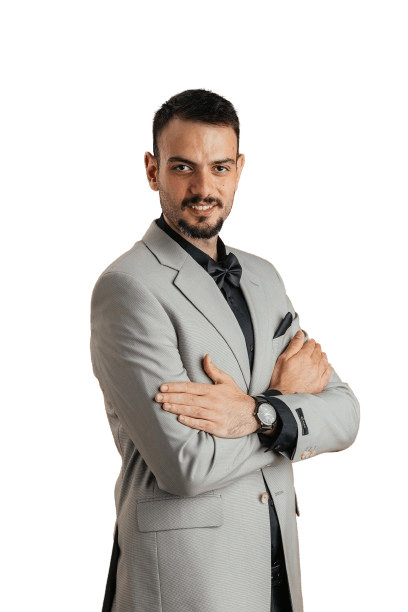
I was born in Syria, and for ten years I lived in Russia, where I studied medicine and then specialized in dermatology. Yes — I'm a doctor.
But at some point I understood that, even though I'd invested many years in that profession, it wasn't the path I truly wanted. And it was precisely during those years that I discovered something that ended up changing my life:
Languages.
When I arrived in Russia, I didn't speak a word of Russian. My English was pretty basic too. And Spanish was still to come.
But I started learning. Russian. Spanish. English. And while I learned, I started noticing something that fascinated me:
What makes a word stop being something we simply know, and start being part of how we communicate?
I realized that what helped me most wasn't memorizing word lists. It was listening. Understanding. Trying to speak. Reading things I could understand. Meeting the same words again and again. And using the language in real situations.
I even talked to myself at home to practice. 😄
Little by little I understood something that became a fundamental idea for me:
A language isn't just a set of rules to study. It's a skill you develop by using it.
Why do we learn our mother tongue so differently?
A child doesn't start life studying conjugations. Doesn't memorize verb tables. Doesn't open a book to learn the past tense.
It doesn't happen all at once. The language builds itself inside their head while they use it. And while learning languages as an adult, I started recognizing some of those same processes in myself. That completely changed the way I think about teaching.
When I began teaching, I had one very clear question:
How can I get a person to not just “know Spanish”, but to actually be able to use it?
Because we all know the traditional method. Grammar. Exercises. Vocabulary lists. Exams. Rules. And more rules.
But many people spend years studying a language without ever feeling able to use it in a conversation. Meanwhile, the people who really do end up speaking often have one thing in common: they've had a lot of contact with the language.
Movies. Series. Songs. Video games. Conversations. Reading. Real life. The language was there, again and again.
That observation sent me looking for a different way to teach.
TPRS stands for Teaching Proficiency through Reading and Storytelling. When I discovered this method, many of the things I'd noticed in my own learning suddenly made sense.
Stories. Questions. Comprehension. Repetition. Interaction. Reading. Language adapted to the student.
And above all: using the language from the start.
Not learning the whole language first and then using it. Using it in order to learn it.
When we work with a story, for example, I don't want you to just listen passively. I want you to be part of it. I ask you questions. You answer. We change details. We imagine situations. Sometimes you're one of the characters.
And while we do all this, certain words and structures show up again and again inside a context you can understand. So the language stops being a list of information. It becomes something you're using.
I don't want you to be able to say, after months of classes: “I know a lot of Spanish rules.”
I want you to be able to say: “I can use Spanish.”
I want you to understand more. To answer more easily. To be less afraid of making mistakes. To hold a conversation that feels more natural every time.
And one day, to catch yourself thinking: “Wait… how do I know how to say this without ever memorizing it?” 😄
I love that moment.
After all these years learning languages and teaching Spanish, my idea is pretty simple:
A language is acquired first, and studied second.
That doesn't mean grammar isn't important. It means grammar makes much more sense once you've already seen and used the language.
That's why in my classes I don't want you to be a student who only watches. I want you to take part. Listen. Understand. Answer. Make mistakes. Try again. And little by little… start living in Spanish.
Today I teach Spanish with TPRS, Comprehensible Input, stories and conversation. I speak four languages: Arabic, Spanish, Russian and English. I've lived in different places, I've learned languages as a student, and I've spent years teaching Spanish.
And maybe that combination is exactly what defines the way I teach: I don't just teach a language. I know what it's like to be on the other side.
That's why I teach the way I teach. So you can start using Spanish long before you feel like you “already know Spanish”.
“I like languages, absurd stories, and asking questions until someone is speaking Spanish without even noticing.” 😎